

That twain quote was something of a mantra for me. I always felt that schools somehow missed the point. Perhaps more than deeply rooted moral opposition, it was my general disinterest in the things I was required to learn. Use it or lose it was the more general educational philosophy I embraced. If I was never going to need to know something I shouldn't need to learn it. Of course it never occurred to me that I couldn't possibly know what I would actually need later on, but I was pretty sure that cursive, hot cross buns on the recorder, and dissecting frogs were all a bit of wasted effort. As it turns out now even spelling is becoming optional.
As much as it pains me to say it: I did actually benefit from my formal education. I think I've identified the most important and influential aspect, the interloper that destroys my proud story of angst and rebellion.
When I graduated high school and started picking college courses, I really had no idea what I wanted to do. I had thought originally about aquacultural engineering since it was an extension of my past experience working fish departments (starting under the table age 11), and having a pond/koi business in high school.
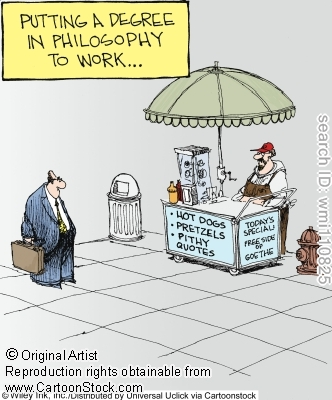
At some point I remember thinking that if I'm here at school anyways, why shouldn't I try to choose a subject to study that is interesting and has the least possibility of me learning it myself? With this thought, I chose philosophy. I still remember the comic that my mom put on the fridge, I'm surprised I found it so easily online (right)
The hot-dog cart for sure. I was never any good at pithy quotes, all the rage with the other majors. I didn't see the need, I was in it for the big answers, I didn't care who they came from or exactly how they phrased it.
After classes escalated to the graduate level seminars later in the degree program, I was reading lot's of Augustine and wrestling with free will. It was the closest I ever came to a belief that "the God" exists.
Shortly thereafter I settled on a more preferable notion that "God" and absolute truth are one in the same, and that scientists and theologians are both talking about the same thing with different names. Additionally it seemed neither knew or could know as much about what they are talking about as they think they can, and I left it there having found for myself a satisfactory enough non-answer to the real nature of the universe. Absolute truth is real, but we'll never know what it is for everything.
The kicker in my philosophy studies though was logic. In retrospect, every aspect of my professional life after college, and every single job I've ever held was in some way a result of my concentration in formal logic.
Steve jobs said in an interview in 1995 that "Learning to program teaches you how to think. Computer science is a liberal art." , but here's the thing. Steve was wrong. I ascribe to as much Jobseyan wisdom as most entrepreneurs, but in this case he's wrong. It's not the programming that teaches you how to think, it's the logic. The programming teaches you how to express and utilize logic in a particular grammar, syntax, and vocabulary via a computer, but it's the logic itself that teaches you how to think. That is why with a good grasp of logic, you can bounce around and learn new languages, verbiage and even cross disciplines and still have a fighting chance, you'll just always have more homework than the other kids to catch up.
I can revisit simple logical proofs that I wrote way back when, and make neither heads nor tails of them. But I can still take real world problems and pretty naturally translate them into workable chunks that then end up allowing easier assessment and much stronger solutions.
When I was a developer I had never taken a CS course in my life, but worked alongside dedicated CS guys many with advanced degrees. You could see the gaps that I had, but none were as detrimental or as difficult to overcome as for the CS guys that had weaker grasp or comfort with logical translation. Some would use the knowledge of a language to work around these gaps, and the result is messy, inelegant, and takes much more time.
Writing and understanding software requirements is a form of logical translation, and is highly valued. It is almost exactly the same skillset as setting product requirements for hardware, of course with different constraints and different spheres of knowledge needed to produce them.
People are sometimes a bit perplexed by my strange transition from philosophy to software, but where I contributed was never in being the best coder. I was awful at best, but I could see the forest for the trees and zoom in or out and evaluate solutions as deeply or as high level as needed, and incorporate/translate English to and from the logic.
When I jumped from software to hardware, the same thing occurred, and I was able to make headway in a space I knew little about to start with. Perhaps this is because of the flexibility and ease of unified thought at multiple levels of the same problem. I really feel that the "zoom"/translation capability was given to me by learning, practicing, and ultimately understanding my logic studies. Ugh. Sorry Mr. Clemens, you were mostly right and I still love you anyhow, you too Steve.